Sunday, 20 November 2011

Caloundra - Trevally & Flathead


Thursday

Back up to Caloundra for another very early start. The same wind pattern, early morning calm followed by a building northerly. The best thing was that the low tide would be after first light, at about 5.45 am.
I walked down onto Bulcock beach at about 4.15 am as the horizon started to glow. After a few casts with a soft plastic – a GULP 5” Jerkshad in the Lime Tiger colour, I had a 40 cm Flathead. It was lying close to the rocks waiting for breakfast to wash by on the outgoing tide. I carried on in the shallow for a while and then turned my attention to the deeper water in the main channel. I swapped to a heavier 1/6th 1/0 jighead – to get a better cast and faster sink rate in the strong current. I had to keep the retrieve fast, so as not to get snagged in the rocks.

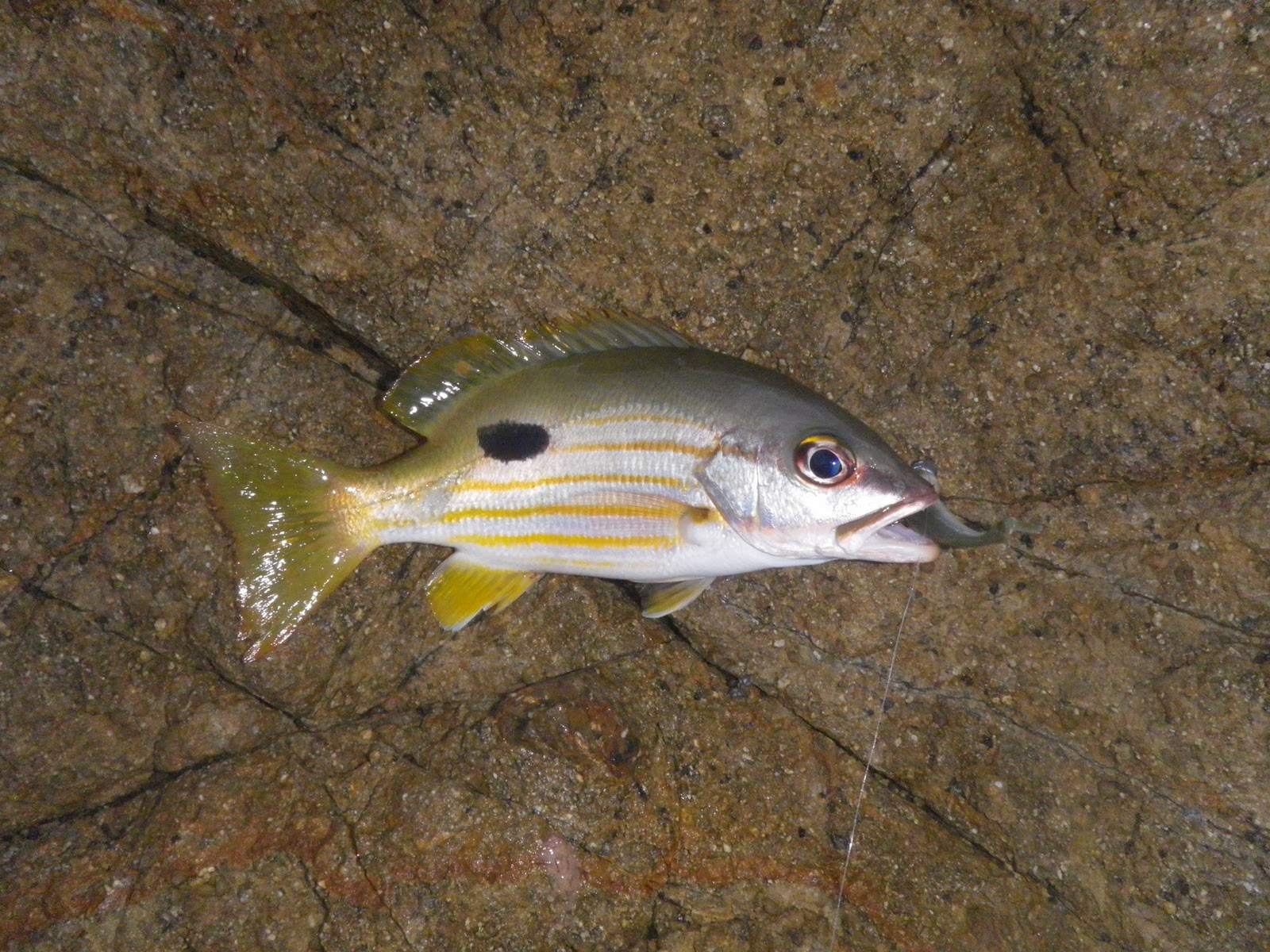
I was back to the 7’6” 2-4kg Nitro rod and fishing with a 12lb fluorocarbon leader – so I would have a little bit more power to play a bigger fish, if I found one. I cast out into the main channel with a GULP 5” Jerkshad in the Pink Shine colour. Not long after it hit the water I felt a bump and then a solid bite. It was not a Flathead out there, so I struck after a short pause. Zzzzzzzzzzzzzzzzzzzzzzzzz – I was on to a fish. After catching only Flathead for a week or two, I was blown away by the pace. It was a Trevally and not a particularly big one, but it charged around, all over the place and I had to tighten the drag several times to subdue it. I towed it back to the beach. It was a Big Eye, a bit less than 40cm long but in the current, it had felt much bigger.


I cast back in the same spot and a few seconds later I was on again. I caught about 8 more over the next 30 minutes, all in the same spot and then as the tide turned, they were gone. They were not fussy about colors and had eaten all of the soft plastics that I threw at them – Pumpkinseed, Pearl Watermelon, Camo, Pink Shine, Vader, Satay Chicken.

I decided to head down to Golden Beach to try out some more hard bodied lures. Inspired by the DUO range I have been trying out, I rummaged through my lure boxes to see what else might catch fish. With these northerly winds I think the Flathead are not feeding very aggressively and the vibes and rattles can stir them into a strike, even when they are not really feeding. I found an old, small shallow diving minnow with a good rattle in it and I decided to give it a try. I walked on to the sand banks in front of Gemini Towers and waded out, casting along the edge of the channels and drains, after 5 minutes, I felt a bite but no hook up and after 10 minutes, I was on. It was a small Flathead, just over 40cm but perhaps my theory was right. I released it and a few minutes later I was on to a much bigger one. Unfortunately, I was now about 80 metres from the nearest sand bar and on the walk back it wriggled free. The problem with a lot of hard bodied lures, is the small, puny treble hooks.

I decided to switch to a Strikepro Vibe lure that looked very like the Herring that were floating around the weed beds. It was a 14g, 70mm bibless sinking lure with a decent rattle and good action. Not as refined as the DUO REALIS that I had lost on Tuesday, but pretty close.  The first cast travelled 20 metres and sploshed above the weed, on the edge of the channel. A few metres into the retrieve it was rattling along nicely and I could feel the vibrations in the rod tip. Suddenly, it stopped there was splash and I had another Flathead on the line. This was another fish around 40cm long.


It was now around 11 am and as predicted, the northerly was picking up. I decided to give up for the day. I was impressed that both of the ‘noisy’ hard bodies, I had selected had caught fish. The trouble is, I may be about to swap a soft plastic lure addiction for a much more expensive, hard bodied lure addiction!


Saturday, 19 November 2011

Caloundra - A big lizard and a new lure

Ok - forget about the wind, I told myself. Yes it would be from the north – but the fish must still be there – somewhere, and it was not forecast to pick up until about 9.00 am. Low tide would be at 4.00 am at Caloundra and the top end of the Pumicestone Passage is a little more sheltered than the bottom end,  in a Northerly – so that was my destination.

It would have to be an early start – first light would officially be at about 4.15 am , but over the last few weeks, the fish appear to be out hunting for their breakfast as soon as the horizon starts to glow – from about 3.45am. So I set out from Brisbane at 2.45am and reached the rocks on Bulcock Beach at about 3.50 am.
There was no wind and the tide was still running out, but beginning to slow. I started with a GULP 5” Lime Tiger Jerkshad on a 1/6th 2/0 jighead. I cast around the base of the rocks and then waded a fair way out into the shallows. The sand gives way under foot and is constantly moving so you have to watch your step. I was casting just on the edge of the rock bar, which skirts the bank beneath the boardwalk and the car park. I got snagged and re-rigged.

A couple of seconds after the soft plastic hit the water a fish hit it. It must have been slowly sinking down the water column. Unfortunately, after a few days fishing with my heavier spin rod (Nitro 2-4kg) I had swapped back to the light one – the Loomis GL2. It was bent over and the reel was screaming. I had a 12lb leader and the knots would probably hold but I could not exert any pressure on the fish, through the rod. It was running all over the place, out in the middle of the channel. I tightened the drag but it made little difference. It went where it wanted. After about a minute and a half, it changed tactics and headed back in towards the rock bar. As soon as it got next to the rocks, the line went slack and it was gone. I think it had just knocked the jighead and plastic loose on the rocks. Given the powerful runs and its speed, I would think it was a Trevally – who knows?

I cast around hoping there might be a school of them but there were no more takers. I moved into the shallows and decided to try another of the DUO lures I have been sent from Japan. This time I would be using the REALIS VIBRATION 62. It is another beautifully crafted lure. It is a blade shaped vibe lure made of resin with a clever weighting system that means a really consistent swimming action, even when retrieved quickly. The rattle is loud and effective - I think it annoys the hell out of the Flathead – and can stimulate a strike from a fish that would not otherwise be feeding. It weighs 11 grams and is 62mm long, so it can be cast a fair distance and hugs the bottom, even on a fairly fast retrieve.


I carefully worked the REALIS lure over the sandy patches, I could hear the rattle from several metres away. I felt a bite – or was it a snag? I kept it moving pretty fast as I did not want to lose it. The next cast, across the same piece of sand was definitely grabbed and then dropped. Third time lucky – I cast back out and this time the fish made no mistake. There was a splash and head shake as it realized it had eaten something prickly, but it was solidly hooked. I pulled it up on the sand, it was a 52cm Flathead.
I went back to the same area and worked the lure closer and closer to the rocks until, inevitably, it got caught amongst the rocks and that was that. This seems to happen to a lot of my lures!

I took the hint and moved down the Passage to fish amongst the weed beds and sandbanks around Diamond Head. The water had just started to cover the weed along the edge of the channel. I walked across the sand bar to the green channel marker that marks the deeper water in the main channel. There were small flathead lies all over the sand bar, clustered in little groups. I cast around and caught a few small Flathead on a GULP 3” Minnow soft plastic in the Pearl Watermelon colour – between 25 and 35 cm.


After an hour of wading along the edge of the main channel, I decided to drive back up to Golden Beach and try my luck there. The tide was now almost high and the weed banks in front of the Powerboat Club looked like a good target. I waded north from the club, casting along the edge of the sand banks. It was now about 10.30 am and the Northerly wind was starting to pick up, roughening the surface of the water. I waded slowly, changing the soft plastic lure regularly and making sure I moved carefully and quietly. It may be choppy on the surface but it is calm down below. After 45 minutes of this I felt a nice solid bite close in to a clump of weed. I paused, counted to ten, then struck. There was a long slow pull, then a pause, then zzzzzzzzzzzzzzzzzzzzzzzzzzzzzzzzz and zzzzzzzzzzzzzzzzzzzz and zzzzzzzzzzzzzzzzzzzzz. I checked the drag, it was set right with a fair bit of pressure – this was a decent fish. I started to get some line back and moved towards the shore. There were plenty more solid runs but eventually I got a look at a very good Flathead. I kept the rod tip bent and slowly dragged the fish up onto the sandy beach. It was a big female that measured in at just under 75cm. I thought about it, but she was too good looking to keep for dinner. The lure was now a long way down her throat so I decided to cut the line and leave it to be digested. After a few snaps, she swam away.

Despite the northerly wind it had been a good session with a cracker of a fish to finish up. I’ll be back!

For more reports, photographs and fishy yarns - read the blog at http://landangler.wordpress.com/

Monday, 14 November 2011

Bribie Island - Pacific Harbour & Buckley's Hole

Monday

I wasn’t planning to fish today. I couldn’t get away until 8.00 am and thought that might be too late. But it was such a beautiful day that I decided I would go anyway.  I drove up to Bribie and dropped in on Nigel at the tackle shop, in Ningi.  As usual, he provided some good local knowledge and told me who was catching what, where and when.

I took his advice and decided to fish some new ground, to the north of the mouth of the Pacific Harbour canal development, on Bribie Island. High tide had passed at around 7.00 am and it was now about 9.00 am. This is a great fishing spot. It has everything – weed beds, sand banks and the coffee rock ledge that runs the length of the Pumicestone Passage.

I started just north of the wading bird sanctuary and started casting around with a GULP 5” Jerkshad in the Satay Chicken colour. I had been fishing the longer Crazylegs Jerkshad soft plastics at the end of the previous session and had left the slightly heavier and wider gape 1/6thoz, 2/0 jighead on. I have begun to conclude that anything bigger than a 1/0 hook jighead, can reduce you hook up rate with the Flathead. I don’t think it affects their eagerness to eat the lure but I think the bigger hook does not lodge so effectively in the jaw of the very flat mouth.

After about ten minutes I felt a bite, paused and struck, I had a good size fish on, but after about twenty seconds, it wriggled off the jighead. I waded a little further south, towards the mouth of the Pacific Harbour development. Just short of the entrance, I was retrieving my lure and about to lift it from the water to cast again. A Flathead launched itself at the lure and grabbed it, just as it came out of the water. I nearly jumped out of my skin. It turned and ran and I tried to set the hook but failed again and it was gone.

I changed down to a lighter and smaller gauge jighead, a 1/8th 1/0 hook, and moved back north, wading and casting, wading and casting. I tripped over an unmarked crab pot and then another. The water is still quite muddy and murky in places, even though there has been no rain for a while. Finally, after more than one hour, I hooked up with a 25cm Flathead.  I released it and decided to switch locations.

I drove down to Bongaree, to the mouth of the tidal lagoon in front of Buckley’s Hole. It was just about low tide by the time I got there. I cast over the edge of the coffee rock ledge and moved south from a spot just in front of the new museum. After a couple of casts, bait started skipping around and I caught a small Chopper Tailor  - about 25cm long.

I decided I had missed my chance of catching a good fish earlier in the day and so at about 12.30 pm, I gave up and went home.


Saturday, 5 November 2011

Bribie Island & Caloundra

Thursday

On Thursday I was relieved to see that the wind would be from the south, but disappointed that it would be up to 20 knots by 10 am. I drove up to Bribie Island for first light, at around 4.30 am and started on the mainland side under the bridge. It would be a big high tide – 2.5m at about 9.30 am. That meant it would run in very quickly, covering my favorite fishing spots in a couple of hours. Most of the places I like to fish are at their best two hours before and after low tide.

I put on a GULP Crazylegs Jerkshad soft plastic in the Black Shad colour and fished it around the rocks, which sit just to the south of the bridge, about 5 pylons from the shore. There was plenty of surface action with the mullet and herring getting attacked under the bridge lights. Every now and then a mullet would skitter by with something fast in hot pursuit. I swapped down to a smaller soft plastic – the GULP 3” Minnow in the Lime Tiger colour. The tide was running in strongly but I did not want to fish any heavier than a 1/8th oz 1/0 jighead - it is too easy to get snagged in this terrain with a 1/6th oz jighead. There is a channel that runs through the middle of the rocks and it has produced a few good fish for me. I cast to the south and hopped the plastic along – pretty quickly, with the current, through the channel, back towards the bridge. There was a tug then a pause then a solid, angry bite and I had hooked up. It came straight up and shook its head angrily then swam away again taking some line. It was a good Flathead about 55cm long.
I waded south but again the weed started to cause problems. There is a point when the tide runs in, just as the water submerges the previously exposed sea grass that you just cannot cast without your lure getting instantly clogged up. I had reached that point.

With not many good high tide options available, I decided to drive up to Caloundra and explore the land-based fishing further up the Pumicestone Passage. I parked by the Power Boat Cub and decided to wade north. It was almost high tide, not the best time to be surveying new ground. The big tide had also loosened the weed here. I cast at the edges of the sand banks and after half an hour, I caught a 45cm Flathead on a GULP 4 “ Minnow in the Pearl Watermelon colour.

There were big schools of Mullet everywhere, drifting over the sand banks close to the mangroves. There were also smaller schools of Garfish that followed the plastic right to my feet on the retrieve. I decided to move a further south and drove down to Jensen Park. The park is beside another creek off the Pumicestone Passage and has a small boat ramp. I waded along the shore and found a few more undersize Flathead. At around noon the wind was howling even in this sheltered spot so I decided to give up.


I had caught the best fish in my first 30 minutes of fishing, but I had explored some new ground and caught a few more along the way – not a bad day.

Saturday, 22 October 2011

1770 - Deepwater National Park - 12 October 2011

Tuesday & Wednesday

I continued to fish the beaches and rocks of Deepwater National Park, just south of Agnes Waters, but the weather was quite changeable. I tended to catch a few fish early in the morning when there was a light south-easterly and then things would go quiet in the afternoon as the wind turned round to a northerly.

I fished the morning high tide at Flat Rock on Tuesday. The rock was covered and I cast from the beach at its inner edge. The Stripeys were sitting under the edge and relentlessly attacked the GULP 3” Pearl Watermelon Minnow. Every now and then I would find a patch of Bream and I caught about four keeper size fish, but none were bigger than 30 cm. There were also a few Whiting. A school of something was moving up and down feeding a hundred meters beyond the rock and the birds where dive-bombing.


At low tide on Wednesday I walked out over the oyster covered rocks at the southern tip of Wreck Rock bay. I have been monster in this spot on several occasions and also seen the Tuna come in close enough to cast at. The overhangs at the base of the rocks also hide plenty of resident fish. I decided to try something new and rigged a GULP 7” Sandworm in the Blood colour on a 1/6th 2/0 jighead. I lost a couple to the small Dart and Butter Bream and then bang! I was hooked up to a better fish. It headed straight down into the rocks and fortunately I had some 16lb leader on. I pulled it out and landed it with the aid of the wash. It was the best Stripey of the week at about 35cm. This is about as big as they get. I cast out again in the same spot and caught a few smaller ones. I carried on fishing around these rocks for about another hour as the water ran out to low tide. As I was retrieving a cast, in close to the rocks, I felt a thump and then zzzzzzzzzzzzzzzzzzzzzzzzz. It was a very hard hit by a decent fish, but suddenly the line went slack and it was gone. I retrieved a mashed soft plastic sand worm. It must have changed its mind.

It had not been a spectacular week of fishing, I had fed myself, enjoyed the surroundings and caught plenty of fish. But I had seen evidence of some monsters lurking and witnessed a few big hook ups. As always, there was just enough to convince me that I need to get back up here soon!

Monday, 17 October 2011

Fishing the rocks at 1770 - Oct 2011

Thursday - Sunrise


I have just returned from a week of fishing at 1770 and its surrounds. I camped at Wreck Rock, about 15kms south of the town of 1770. Wreck Rock is located in Deepwater National Park and can be reached by driving south, out of Agnes Waters, on a sandy four wheel drive track. There are about a dozen campsites dotted through the trees behind the beach, a composting toilet and cold, outdoor shower, fed by bore water. There is also a large rainwater tank for drinking water. It is a very quiet spot and is an ideal base to fish the surrounding headlands and beaches.

I did a little research on Google Earth prior to this trip and located a few spots that I would try to fish. I was looking for spots with a bit of deep water and structure, in close to the shore. My trips to this area, over the last couple of years, have usually produced similar results - I can usually catch a respectable tally of Trevally, Bream, Dart, Whiting, Spanish Flags (Stripy Perch) and the odd Flathead that provide my daily sustenance. But the bigger fish can be harder to locate.  There are very fishy looking spots at the end of almost all the beaches and bays, but they do not all hold fish. One problem is that the big fish in this area, the pelagic species – move fast and they keep moving, chasing the bait schools up and down the beaches. If you are land based, you cannot really follow them. You just have to pick a likely spot and hope they will come by. Invariably, by the time they arrive you have downgraded to your light gear, to try and catch the smaller fish and so when the rod bends over and the reel starts screaming, you don’t have the power you need to subdue the fish.

On Thursday morning I focused on the headlands just south of the main look out at 1770 (see aerial photo). The bay I was fishing was just below Ocean Drive. It is a sheltered cove with plenty of bommies and a beach covered on boulders. I started on the north side, fishing from atop a large rock that sticks out into the bay. I was using a new rod – the Shimano Catana Coastline Light. It is a light weight 10’ 6” rod that is rated 3-6 kg. It is ideal for casting soft plastics on 1/8th oz to 3/8th oz jigheads for Dart, Bream and Whiting but it will also land bigger Tailor, Trevally and even school Jewfish, if carefully handled. The longer length means it casts well in the surf. I was using a Shimano Stradic 3000 spin reel – which is probably a bit small for the rod. I had the reel loaded with 12kg breaking strain braid and a couple of metres of 12lb fluorocarbon leader.

It was about half an hour after dawn when I started fishing. The first cast produced a fish – a 25cm Stripey or Spanish Flag. These fish are everywhere around the rocks. They are part of the Mangrove Jack family and taste fantastic. Unfortunately they rarely get much bigger than 35 to 40cm and when you catch them around the rocks they are usually under 30 cm. The legal size is 25cm but they are not really worth keeping until they reach about 30 cm. At this size they have a couple of decent fillets that will make a meal. I let the first one go and caught a few more on the next few casts. I was using a GULP 3” Minnow soft plastic in the Pearl Watermelon colour on a 1/8th 1 hook jighead.

I moved around to the other side of the bay and cast out into the middle. I felt plenty of hits from small fish and eventually hooked a Whiting – also just about 25cm long.  A few more followed and I decided to switch to a 1/4 oz blade lure. This immediately attracted the attention of the Dart and I caught several small ones. They did not get any bigger so I swapped back to the soft plastic Pearl Watermelon minnow and moved further round the bay to the next headland. Here, I cast out into the wash behind a half-submerged bommie. I felt a few more hits and hooked up with more small Stripeys. The wind was getting stronger from the north so I decided to give up for the day. I had not really caught anything decent but I had explored another new spot and caught a few fish.

Wednesday, 14 September 2011

A decent Jewfish from Fingal Head


Tuesday

Tuesday morning looked windy again and the swell would be up. Ideal Jew conditions - if I could find a safe spot to fish. I started on the south rock wall at the Tweed Rived mouth, just before dawn. The tide was coming in and there was a cold westerly blowing. It would be high at about 8.30 am. I cast all around the end of the wall with soft plastics, slugs and a big hard bodied minnow lure, but did not find any fish.

I decided to move down to Fingal Head. The swell was building up and when I arrived I was in two minds about crossing over on to the causeway, to fish. I watched for half an hour and then finally got across and stashed my gear on some dry rocks. The swell was now crashing in and there was white water all around. I rigged up a 5” GULP Black Shad Crazylegs Jerkshad on a 1/2oz, 2/0 jighead. I was fishing with my 9’ Daiwa Demon Blood and Shimano Stradic 6000, loaded with 30lb Bionic braid and a rod length of 30lb Fluorocarbon Rock – leader. I had to stay at the back of the promontory as the front was getting a bashing. I cast out and felt a few tugs on the retrieve. On the next cast I had a fish, it was a Dart – just about big enough for the table.

The got the hang of the waves and concentrated on fishing during the calmer period, in between the big sets. There were birds everywhere and I presume there were some Tailor somewhere nearby. After a few more casts, I felt a solid hit as the lure sank. I lifted the rod but did not hook up. I dropped it again and paused. When I lifted it again the rod tip bent over and line started peeling off the reel. This wasn’t a Dart. Fortunately the swell was working for me and pushing the fish in. After a couple of strong runs I saw Jewfish. I pulled it up the rocks, with the aid of a surging wave and got my hand in, under its gills. It was a good fish at around 80cm, in excellent condition. There was nothing in its stomach. It was just after 8.00 am.

I cast back out in all directions, but I could not find another so, at about 9.00 am I gave up, cleaned the fish and crossed back over the causeway. After too many disappointing sessions recently it was great to be carrying a decent fish back to the esky.


For more reports, photographs and fishy yarns - read the blog at http://landangler.wordpress.com/